
India’s fiscal federal architecture stands on a delicate balance—one that decides how resources flow between the Centre and the States. Every five years, the Finance Commission becomes the architect of that balance.
As we move closer to the 2026–31 cycle, the 16th Finance Commission has come into focus, sparking discussions on revenue sharing, state debts, cess collections, and the future of cooperative federalism.
For UPSC aspirants, this topic is a goldmine—touching Polity, Economy, Federalism, Governance, and even Current Affairs.
This article breaks down the latest developments in a clean, blog-ready format—easy to grasp, easy to revise, and optimized for Google indexing.
Understanding the Finance Commission: The Constitutional Backbone
The 16th Finance Commission (2026–31): Who, When, Why?
The 16th Finance Commission has been constituted for the five-year period beginning April 2026.
📌 Chairman:
Arvind Panagariya, noted economist and former Vice-Chairman of NITI Aayog.
📌 Why is it important now?
Because India is facing:
- Rapidly rising state debts
- Post-pandemic fiscal imbalances
- Friction over cess/surcharge collections
- Stagnating local body revenues
- Growing demands for higher state autonomy
This commission will shape how the Indian economy distributes wealth until 2031.
Government-Approved Terms of Reference (ToR)
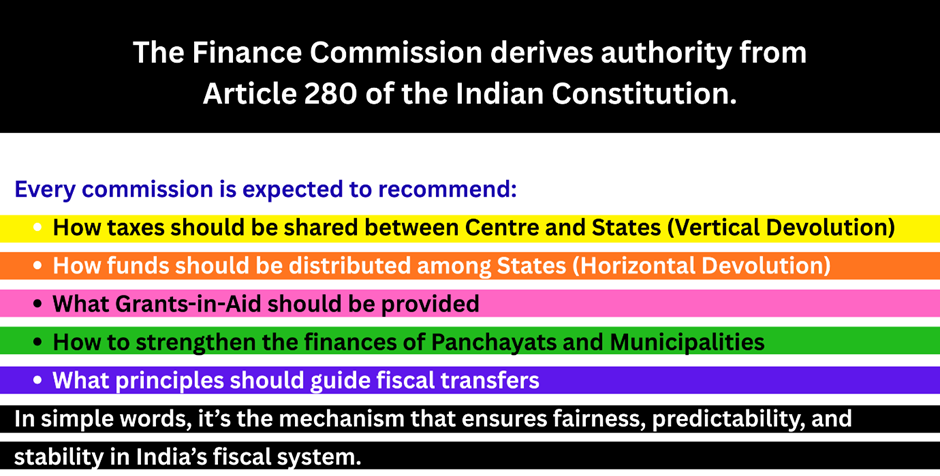
The ToR provides the guiding framework for the 16th Finance Commission. Key points include:
1. Recommend the share of states in central taxes
This determines how big the “pie” is for the States.
2. Recommend the distribution among States
This is the formula part—population, income distance, forest cover, tax effort, etc.
3. Strengthen local body finances
Panchayats and Urban Local Bodies are expected to receive fresh guidelines for fund allocation.
4. Examine state debts & fiscal sustainability
Given the rising indebtedness, this is crucial.
5. Review cess and surcharge collections
A major point of friction:
Cess and surcharges are not shared with states.
What States Are Demanding from the 16th Finance Commission
Different states have placed their expectations before the commission. Some major themes:
📌 1. Increase States’ Share to 50%
Currently: 41%
Demand: 50%, citing growing responsibilities in welfare and infrastructure.
📌 2. Assistance for Highly Indebted States
Punjab, West Bengal, Himachal Pradesh—these states want:
- Revenue deficit grants
- Special assistance packages
- Debt restructuring
📌 3. Revisiting Income Distance Formula
Some states argue for a lesser weightage as the formula disproportionately affects developed states.
📌 4. Bring Cess & Surcharges into the Divisible Pool
This is the biggest long-term demand.
Expected Recommendations (Based on Current Discussions)
While the final report will arrive by late 2025, early indicators suggest:
1. Vertical devolution may remain at 41% or rise to 42%
A marginal increase is being explored.
2. Fresh weightage criteria for horizontal distribution
Possibly:
- Reduced weight for income distance
- Environmental & sustainability parameters
- Demographic change factors
3. Stronger guidelines for local body finance management
To boost autonomy and reduce reliance on state-approved grants.
4. Enhanced monitoring of state fiscal discipline
FRBM Act-linked incentives may be recommended.
5. Special grants for financially stressed states
To maintain development momentum.
Challenges Before the 16th Finance Commission
Every Finance Commission faces challenges, but this one inherits a post-pandemic economy.
1. State Debt Stress
Many states’ debt-to-GSDP ratio exceeds recommended limits.
2. Cess & Surcharge Complications
With nearly 15–20% of revenue locked in cesses, the divisible pool shrinks.
3. Fiscal Inequality Among States
Large variations in per capita income create imbalance.
4. Weak Local Governance Finances
Panchayats and municipalities rarely utilize their tax-raising powers fully.
5. GST Compensation Ending
States argue they need more help after compensation ceased in June 2022.
UPSC Significance: Why You Must Study This
Prelims Relevance
- Article 280
- Constitutional bodies
- Grants-in-aid
- Finance Commission structure
Mains GS-II (Polity & Governance)
- Centre–State relations
- Cooperative & competitive federalism
- Powers and limitations of the Finance Commission
Mains GS-III (Economy)
- Fiscal policy
- Deficits & debt
- Revenue distribution
- Public finance challenges
Essay & Interview
Topics like “Is India truly federal?”, “Fiscal decentralization”, “State financial autonomy” often draw from Finance Commission debates.
Key Takeaways for UPSC Aspirants
- The 16th Finance Commission will determine India’s fiscal alignment for 2026–31.
- States want a greater share and stronger support due to rising expenditure.
- Cess/surcharge issues may reshape future tax-sharing debates.
- Local bodies may receive more autonomy and structured funding.
- Fiscal discipline will become a key theme in recommendations.