

Understand the key concepts of Fiscal Deficit, Revenue Deficit, and Primary Deficit in the Indian Budget. Comprehensive and updated UPSC notes by Vijetha IAS Academy for Prelims and Mains (GS Paper 3).
Introduction: Understanding Budget and Deficit Concepts
Every year, the Union Budget of India reveals the financial health of the economy. It shows how the government earns (revenue) and spends (expenditure).
When government expenditure exceeds its income, it leads to a deficit.
For UPSC CSE aspirants, understanding the types of budget deficits — Fiscal, Revenue, and Primary Deficit — is essential for Economy (GS Paper 3) and Prelims.
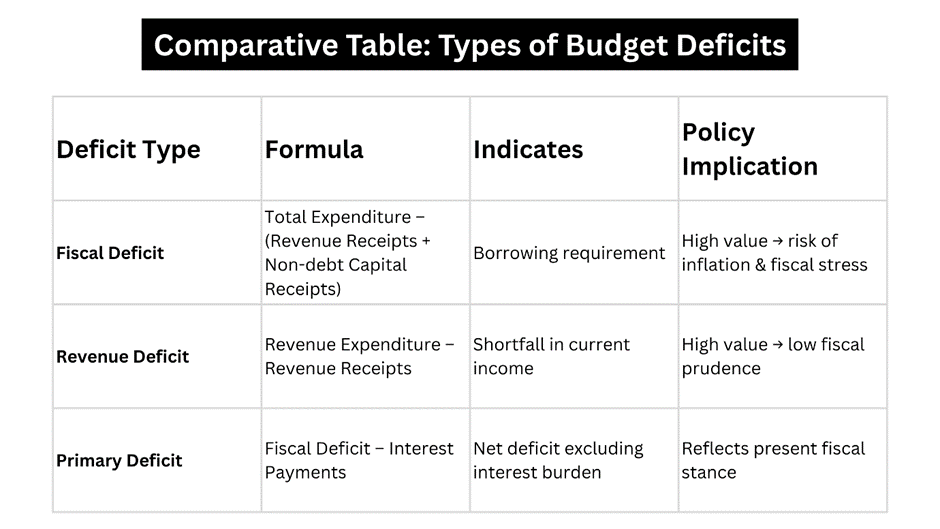
1. Fiscal Deficit – The Broadest Measure of Budget Imbalance
Definition:
Fiscal deficit represents the total borrowing requirement of the government in a financial year.
It shows the gap between total expenditure and total receipts (excluding borrowings).
Formula:
Where,
- Revenue Receipts = Tax and Non-tax income (like GST, corporate tax, dividends, etc.)
- Non-debt Capital Receipts = Recovery of loans, disinvestment proceeds
- Total Expenditure = Revenue + Capital expenditure
Example (2024-25 Budget Estimates):
- Total Expenditure: ₹47.66 lakh crore
- Total Receipts (excluding borrowings): ₹36.37 lakh crore
- Fiscal Deficit = ₹11.29 lakh crore (5.1% of GDP)
Significance:
- Indicates government borrowing needs.
- A high fiscal deficit may lead to inflation and crowding out of private investment.
- It is a key parameter under the FRBM Act (Fiscal Responsibility and Budget Management Act), which aims to maintain fiscal discipline.
2. Revenue Deficit – When Current Income Falls Short of Current Expenses
Definition:
Revenue deficit occurs when the government’s revenue expenditure exceeds its revenue receipts.
Meaning in Simple Terms:
It shows the government’s inability to meet its day-to-day expenses (like salaries, subsidies, pensions) from its regular income.
Example:
If the government earns ₹30 lakh crore (tax + non-tax) and spends ₹33 lakh crore on revenue expenditure,
→ Revenue Deficit = ₹3 lakh crore.
Implications:
- Indicates that the government is borrowing even to finance current consumption, not just investment.
- Persistent revenue deficit reduces the government’s ability to invest in productive capital assets.
3. Primary Deficit – Fiscal Deficit Minus Interest Payments
Definition:
Primary deficit measures the current year’s fiscal imbalance, excluding interest payments on past loans.
Example:
If Fiscal Deficit = ₹11 lakh crore and Interest Payments = ₹7 lakh crore,
→ Primary Deficit = ₹4 lakh crore.
Interpretation:
- It shows how much of the government’s borrowing is due to current year’s expenditure and not because of interest burden on past debt.
- If the primary deficit is zero, it means all borrowings are used only to pay interest, not for new expenditure.

4. Why Budget Deficits Matter for India
- Economic Growth vs Fiscal Prudence: Moderate deficit spending can stimulate growth, but excess borrowing causes debt accumulation.
- Fiscal Deficit Target: Under FRBM Act, the government aims to reduce fiscal deficit to 4.5% of GDP by 2025-26.
- Revenue Deficit Reduction: Focus on reducing revenue deficit to free up resources for capital formation (infrastructure, health, education).
- Primary Deficit Importance: Indicates if the government’s fiscal stance is sustainable in the long run.
5. Government Strategies to Control Deficits
- Boosting Revenue:
- Expanding tax base through GST compliance, reducing tax evasion.
- Divestment of PSUs and asset monetization.
- Rationalizing Expenditure:
- Reducing non-essential subsidies and administrative costs.
- Increasing efficiency in welfare schemes through Direct Benefit Transfer (DBT).
- Debt Management:
- Adhering to FRBM targets and improving fiscal transparency.
- Promoting Growth:
- Higher GDP growth improves tax revenue automatically (fiscal buoyancy).
Conclusion
A sustainable fiscal policy requires balancing growth-oriented spending with fiscal discipline.
While Fiscal Deficit indicates total borrowing needs, Revenue Deficit exposes consumption inefficiency, and Primary Deficit helps assess the true fiscal stance.
For UPSC aspirants, understanding these deficit types is crucial to interpreting the Union Budget, FRBM targets, and macroeconomic policy direction of India.