

Delhi’s air pollution is a result of a complex interplay between anthropogenic emissions, geography, and meteorology. Seasonal factors like temperature inversion, low wind speed, and high humidity trap pollutants, while the city’s basin-like location in the Indo-Gangetic Plain limits dispersion. Key contributors include vehicular emissions, industrial activity, construction dust, stubble burning in neighboring states, and secondary pollutants like ground-level ozone.
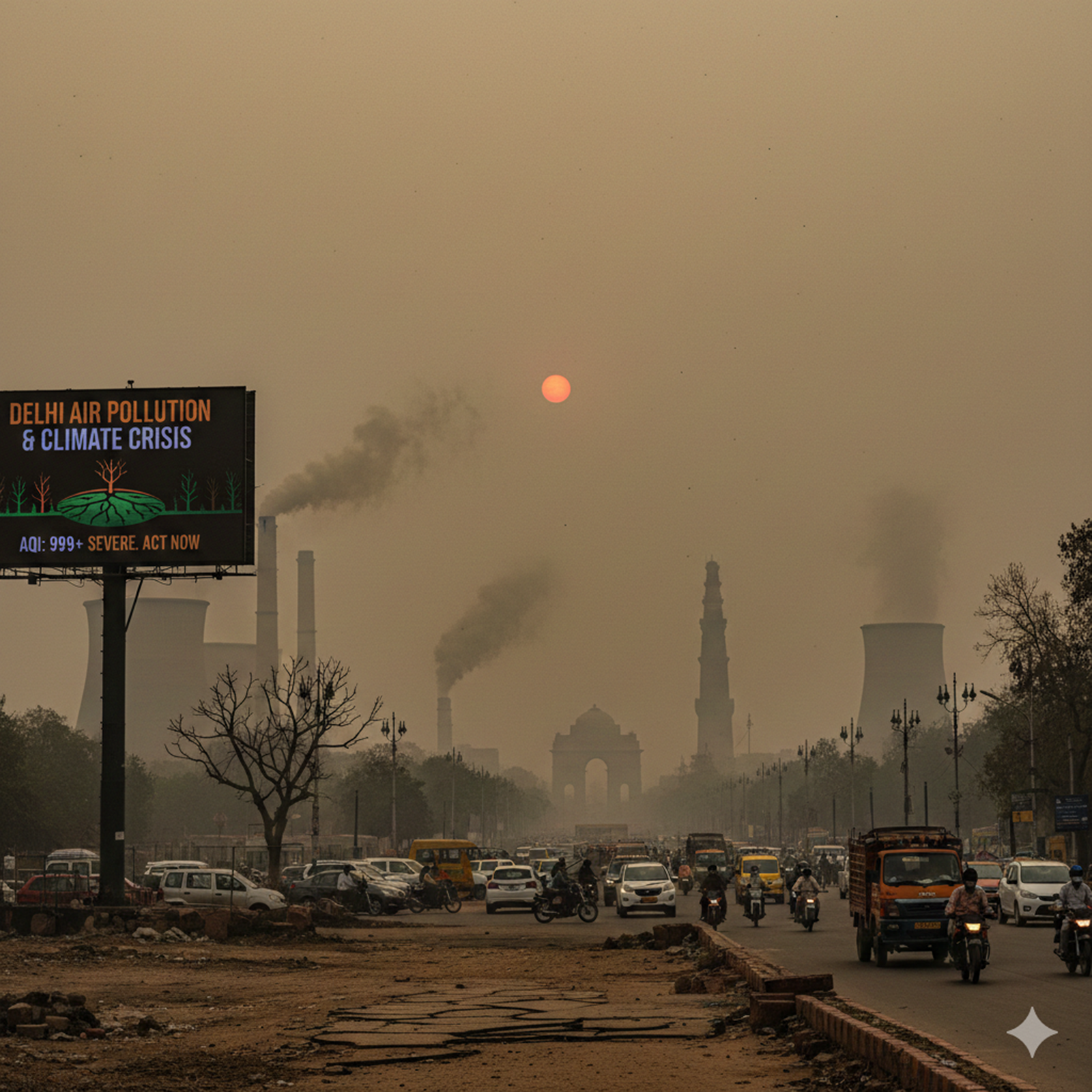
1. Winter Air Pollution: Role of Geography and Meteorology
During winter, air pollution intensifies due to the combined influence of atmospheric conditions and regional geography.
- Temperature Inversion
- In winter nights, the ground cools rapidly, making the air near the surface colder than the air above.
- This creates a temperature inversion layer that acts like a lid.
- As a result, vertical mixing of air is suppressed, and pollutants emitted near the surface remain trapped.
- Low Wind Speed
- Winter is characterized by calm or weak winds.
- Reduced wind speed limits horizontal dispersion of pollutants.
- Pollutants accumulate over cities instead of being dispersed.
- High Humidity and Fog
- High moisture content in winter air leads to frequent fog formation.
- Fog droplets combine with particulate matter (PM₂.₅ and PM₁₀).
- This process traps pollutants near the ground and worsens visibility and air quality.
- Geographical Location – Indo-Gangetic Plain
- Delhi is located in the Indo-Gangetic Plain, a vast low-lying region.
- Surrounded by the Himalayas to the north, the region experiences a basin-like effect.
- This restricts large-scale air movement and prevents pollutants from escaping.
- Seasonal Pollution Peak (October–January)
- These unfavorable meteorological conditions coincide with increased emissions (biomass burning, stubble burning, festivals).
- Hence, air pollution peaks every year from October to January.
Winter air pollution is aggravated by temperature inversion, low wind speed, high humidity, and the basin-like geography of the Indo-Gangetic Plain, leading to seasonal pollution peaks.
2. Particulate Matter (PM₂.₅ and PM₁₀)
Particulate Matter (PM) refers to a mixture of extremely small solid particles and liquid droplets suspended in the air. Based on size, it is mainly classified into PM₂.₅ and PM₁₀, both of which significantly impact air quality and human health.
- PM₂.₅ (Particles ≤ 2.5 μm)
- PM₂.₅ particles are extremely fine and lightweight.
- Due to their small size, they bypass the body’s natural defense mechanisms of the nose and throat.
- These particles penetrate deep into the alveoli of the lungs and can even enter the bloodstream, causing respiratory, cardiovascular, and neurological disorders.
- PM₂.₅ primarily originates from vehicular emissions, fossil fuel combustion, biomass burning, and industrial processes.
- In urban areas like Delhi, PM₂.₅ is the most critical pollutant driving AQI deterioration, especially during winter.
- PM₁₀ (Particles between 2.5–10 μm)
- PM₁₀ particles are comparatively larger and heavier.
- They mainly affect the upper respiratory tract.
- Major sources include road dust, construction activities, soil dust, and mechanical processes.
- Although harmful, PM₁₀ tends to settle faster and is less persistent in the atmosphere than PM₂.₅.
- Dominance of PM₂.₅ in Delhi’s AQI
- Delhi’s Air Quality Index (AQI) values are largely governed by PM₂.₅ concentrations.
- During winter, meteorological conditions such as temperature inversion and low wind speed further enhance PM₂.₅ accumulation.
- WHO Standards vs Indian NAAQS
- The World Health Organization (WHO) prescribes much stricter limits for PM₂.₅ and PM₁₀ based on health risk assessments.
- India’s National Ambient Air Quality Standards (NAAQS) are relatively lenient, reflecting socio-economic and feasibility considerations.
- This gap indicates that even air considered “acceptable” by Indian standards may still pose serious health risks.
Fine particulate matter, especially PM₂.₅, is the dominant pollutant in urban air pollution due to its deep lung penetration, high persistence, and strong influence on AQI, with WHO standards highlighting greater health concerns than national limits.
3. Graded Response Action Plan (GRAP)
The Graded Response Action Plan (GRAP) is a statutory, emergency response mechanism designed to tackle worsening air pollution in the Delhi–NCR region through pre-defined, stage-wise actions.
- Institutional Framework
- GRAP is implemented under the Commission for Air Quality Management (CAQM), a statutory body.
- CAQM coordinates actions among central, state, and local authorities across Delhi–NCR.
- AQI-Based Activation
- GRAP is triggered automatically based on Air Quality Index (AQI) thresholds.
- As air quality deteriorates, progressively stricter measures are enforced.
- Four Stages of GRAP
- Stage I – Poor
- Focus on preventive measures such as dust control and mechanized road sweeping.
- Stage II – Very Poor
- Restrictions on diesel generator sets and intensified enforcement against polluting activities.
- Stage III – Severe
- Partial bans on construction activities and restrictions on certain vehicle categories.
- Stage IV – Severe+
- Complete ban on construction and demolition activities.
- Emergency measures such as vehicle rationing, closure of schools, and industrial shutdowns may be imposed.
- Stage I – Poor
- Key Measures
- Ban or regulation of construction and demolition activities
- Vehicular restrictions, including curbs on diesel vehicles
- Enhanced public transport and control of industrial emissions
- Measures are graded, meaning they become stricter as pollution worsens.
- Regional Applicability
- GRAP applies uniformly to the entire Delhi–National Capital Region (NCR).
- This regional approach acknowledges the transboundary nature of air pollution.
GRAP is a graded, AQI-linked emergency framework implemented by CAQM to manage severe air pollution episodes in the Delhi–NCR region through escalating control measures.
4. Crop Residue Burning (Stubble Burning)
Crop residue burning, commonly known as stubble burning, refers to the practice of burning leftover crop straw after harvest to quickly clear fields for the next sowing cycle.
- Regional Concentration
- This practice is mainly observed in the paddy-growing regions of Punjab and Haryana.
- Paddy straw has high silica content, making it unsuitable for cattle feed and difficult to manage mechanically.
- Seasonal Occurrence (October–November)
- Stubble burning occurs primarily during October–November, coinciding with the paddy harvest season.
- The narrow time gap between paddy harvesting and wheat sowing compels farmers to resort to burning.
- Transport of Pollutants
- Pollutants released—such as PM₂.₅, PM₁₀, carbon monoxide, and nitrogen oxides—are carried towards Delhi–NCR by north-westerly winds.
- Under winter meteorological conditions, these pollutants get trapped over the region.
- Episodic Contribution
- Stubble burning acts as a significant episodic contributor, sharply worsening air quality during peak burning days.
- However, its impact is short-term and seasonal, rather than persistent throughout the year.
- Relative Role in Delhi’s Pollution
- Scientific assessments show that while stubble burning aggravates pollution episodes, local sources within Delhi—such as vehicular emissions, construction dust, and industry—dominate the annual pollution load.
- Hence, focusing only on stubble burning risks overlooking structural urban pollution sources.
Crop residue burning in Punjab and Haryana episodically intensifies Delhi’s winter pollution through pollutant transport, but long-term air quality is primarily driven by local emission sources.
5. Ground-Level Ozone Pollution
Ground-level ozone (O₃) is a secondary air pollutant, meaning it is not emitted directly from any source but is formed in the atmosphere through chemical reactions.
- Secondary Nature
- Ozone at the surface is produced when nitrogen oxides (NOₓ) and volatile organic compounds (VOCs)—released mainly from vehicles, industries, and fuel combustion—react in the presence of sunlight.
- Unlike primary pollutants, its concentration depends heavily on meteorological conditions.
- Photochemical Formation
- The formation of ground-level ozone requires strong solar radiation.
- High temperatures accelerate photochemical reactions, leading to higher ozone levels.
- Seasonal Pattern
- Ground-level ozone pollution peaks during summer months, especially in pre-monsoon periods.
- It is generally not a winter-dominant pollutant, as weak sunlight and low temperatures inhibit its formation.
- Meteorological Enhancement
- High temperature, intense solar radiation, and stagnant air enhance ozone accumulation.
- Urban areas with heavy traffic are particularly vulnerable during heatwaves.
- Health and Agricultural Impacts
- Ozone is a strong respiratory irritant, causing chest pain, coughing, airway inflammation, and reduced lung function.
- It also damages vegetation by interfering with photosynthesis, leading to reduced crop yields and forest productivity.
Ground-level ozone is a summer-peaking secondary pollutant formed through photochemical reactions of NOₓ and VOCs, posing serious risks to human health and agricultural productivity.
6. Urban Heat Island (UHI) Effect
The Urban Heat Island (UHI) effect refers to the phenomenon in which urban areas record significantly higher temperatures than their surrounding rural areas, especially during night-time.
- Urban–Rural Temperature Contrast
- Cities absorb and retain more heat during the day and release it slowly at night.
- As a result, urban temperatures remain elevated, particularly after sunset.
- Causes of UHI
- Extensive use of concrete, asphalt, and brick, which have high heat absorption and low reflectivity.
- Dense building structures restrict airflow and trap heat within urban canyons.
- Loss of vegetation reduces evapotranspiration, a natural cooling process.
- Waste heat from vehicles, air conditioners, and industries further increases urban temperatures.
- Reduced Night-Time Cooling
- Unlike rural areas that cool rapidly at night, cities experience slower heat dissipation.
- This intensifies thermal stress, especially during prolonged hot periods.
- Increased Energy Demand
- Higher urban temperatures lead to greater use of air conditioning and cooling appliances.
- This raises electricity demand, often increasing fossil fuel combustion and emissions.
- Link with Heatwaves and Air Pollution
- UHI aggravates heatwave conditions by prolonging high temperatures.
- Elevated temperatures accelerate pollution chemistry, particularly the formation of ground-level ozone.
- Thus, UHI indirectly worsens both thermal discomfort and air quality.
The Urban Heat Island effect intensifies urban warming by reducing night-time cooling, increasing energy demand, and amplifying heatwaves and pollution-related health risks.
7. Climate Change and Extreme Weather Events
Climate change is increasingly altering weather patterns, leading to more frequent, intense, and unpredictable extreme events, with direct implications for air quality and urban resilience.
- Rising Heatwave Frequency and Intensity
- Climate change has led to longer and more severe heatwaves, particularly in urban areas.
- Higher baseline temperatures amplify thermal stress and energy demand.
- Longer Summers and Ozone Formation
- Extended summer seasons with intense solar radiation enhance photochemical reactions.
- This results in increased formation of ground-level ozone, worsening air quality during pre-monsoon months.
- Erratic Rainfall Patterns
- Climate change has made rainfall more irregular and extreme.
- Sudden heavy rainfall causes urban flooding and waterlogging, disrupting transport, damaging infrastructure, and increasing the risk of water-borne diseases.
- Shorter Winters and Pollution Episodes
- Reduced winter duration compresses periods of unfavorable meteorological conditions.
- This leads to short but extremely severe air pollution episodes, rather than prolonged moderate pollution.
- Climate Change as a Risk Multiplier
- Climate change does not act in isolation; it amplifies existing environmental stresses.
- It worsens air pollution, heat stress, flooding, and health vulnerabilities simultaneously, making it a risk multiplier.
Climate change intensifies heatwaves, alters seasonal patterns, and amplifies pollution and disaster risks, acting as a powerful risk multiplier for urban and environmental stress.
8. Health Impacts of Climate Change and Air Pollution
The combined effects of climate change and air pollution pose a major public health challenge, especially in urban areas.
- Respiratory and Cardiovascular Diseases
- Long-term exposure to air pollutants leads to asthma, chronic obstructive pulmonary disease (COPD), heart disease, and stroke.
- Polluted air aggravates pre-existing health conditions.
- PM₂.₅ and Premature Mortality
- Fine particulate matter (PM₂.₅) penetrates deep into the lungs and enters the bloodstream.
- It is strongly linked to premature deaths due to cardiovascular and respiratory complications.
- Vulnerable Populations
- Children, due to developing lungs, and the elderly, due to weaker immunity, are most vulnerable.
- Pregnant women and outdoor workers also face heightened risks.
- Heat Stress During Heatwaves
- Rising temperatures increase cases of heat exhaustion, heat stroke, and dehydration.
- Heat stress often coincides with poor air quality, compounding health risks.
- Public Health Emergency
- The scale and persistence of pollution-related illnesses have led to air pollution being recognized as a public health emergency, rather than merely an environmental issue.
- This necessitates integrated action involving health systems, urban planning, and climate policy.
Air pollution and climate extremes together constitute a major public health emergency, causing widespread respiratory and cardiovascular diseases and disproportionately affecting vulnerable populations.
9. Delhi Climate Action Plan (DCAP)
The Delhi Climate Action Plan is a city-level strategy aimed at mitigating climate change impacts and improving urban resilience.
- Clean Transport and Electric Vehicles
- Focus on promoting electric mobility, public transport, and fuel efficiency.
- Measures include incentives for EV adoption and improved public transport infrastructure.
- Promotion of Renewable Energy
- Expansion of solar rooftops, wind energy, and green energy procurement.
- Reduces dependence on fossil fuels and lowers greenhouse gas emissions.
- Urban Greening and Tree Cover Expansion
- Initiatives to increase parks, green belts, and urban forests.
- Enhances carbon sequestration, mitigates heat, and improves air quality.
- Yamuna River Rejuvenation
- Measures to reduce river pollution, restore wetlands, and improve biodiversity.
- Supports water sustainability and urban ecosystem health.
- City-Level Climate Governance
- DCAP is an example of localized climate governance, integrating policy, technology, and public participation for urban resilience.
The Delhi Climate Action Plan demonstrates a city-level integrated approach to mitigation and climate-resilient urban planning.
10. Global–Local Climate Link
The interaction between global climate change and local urban action is critical for sustainable development.
- Urban Pollution and Global Climate
- Cities like Delhi contribute significantly to greenhouse gas emissions, linking local air pollution to global climate change.
- India’s Climate Diplomacy
- India emphasizes climate justice and equity in global forums like COP, advocating differentiated responsibilities for mitigation.
- Cities as Key Actors
- Urban areas are central to climate mitigation, implementing renewable energy, transport, and waste management policies.
- Complementarity of Local and Global Action
- Local interventions reinforce global agreements such as the Paris Agreement by reducing emissions and enhancing resilience.
- Delhi as a Case Study
- Delhi exemplifies urban climate stress, demonstrating how local policy, pollution control, and climate planning interact with global climate dynamics.
Local urban actions, exemplified by Delhi, are essential to complement global climate mitigation and adaptation efforts.