
India’s growth trajectory depends heavily on the inflow and management of foreign capital. For IAS aspirants, understanding Foreign Direct Investment (FDI), Foreign Portfolio Investment (FII/ FPI), the governing law FEMA, and their influence on the Current Account Deficit (CAD) is essential.
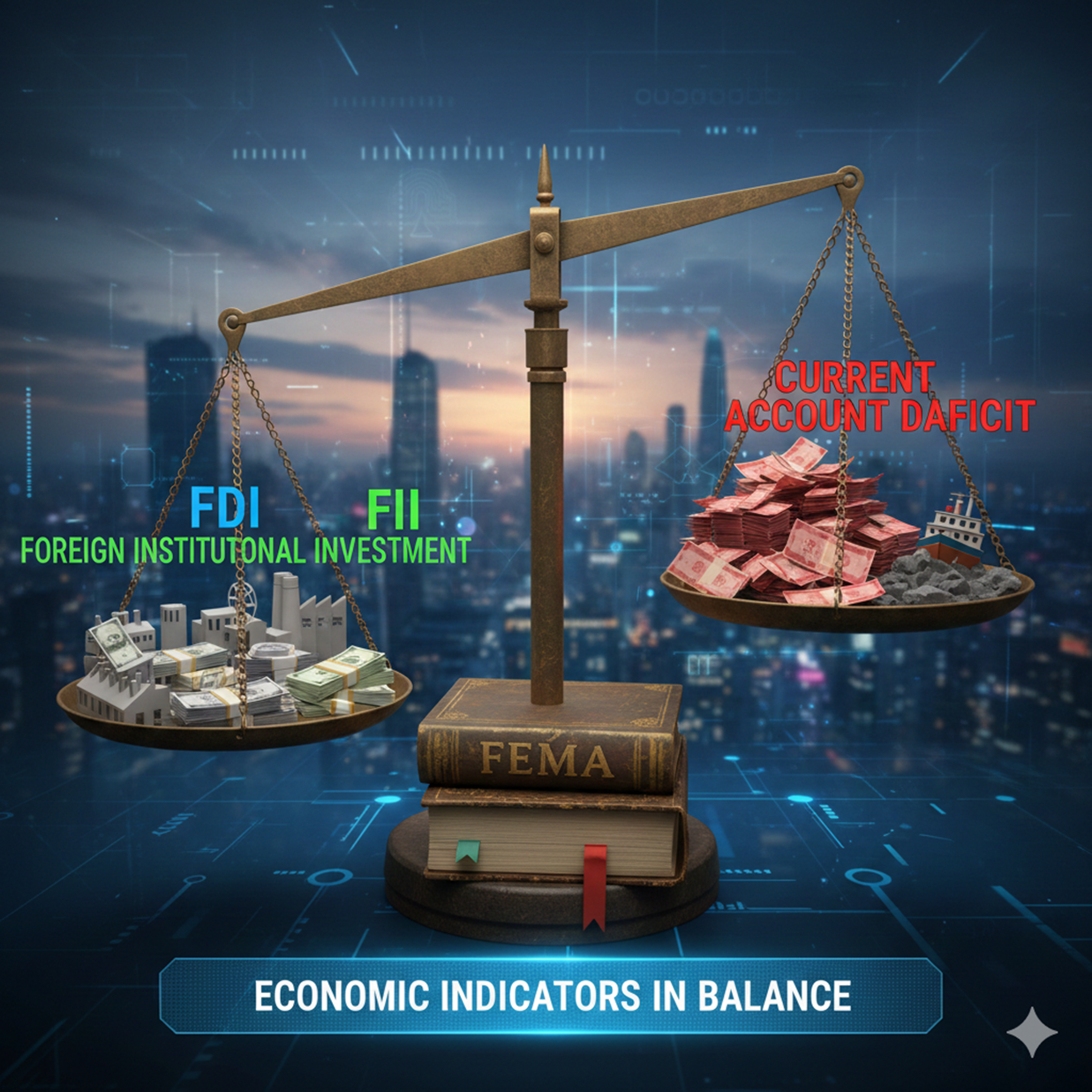
1. FDI vs FII — Understanding the Core Difference
Foreign Direct Investment (FDI)
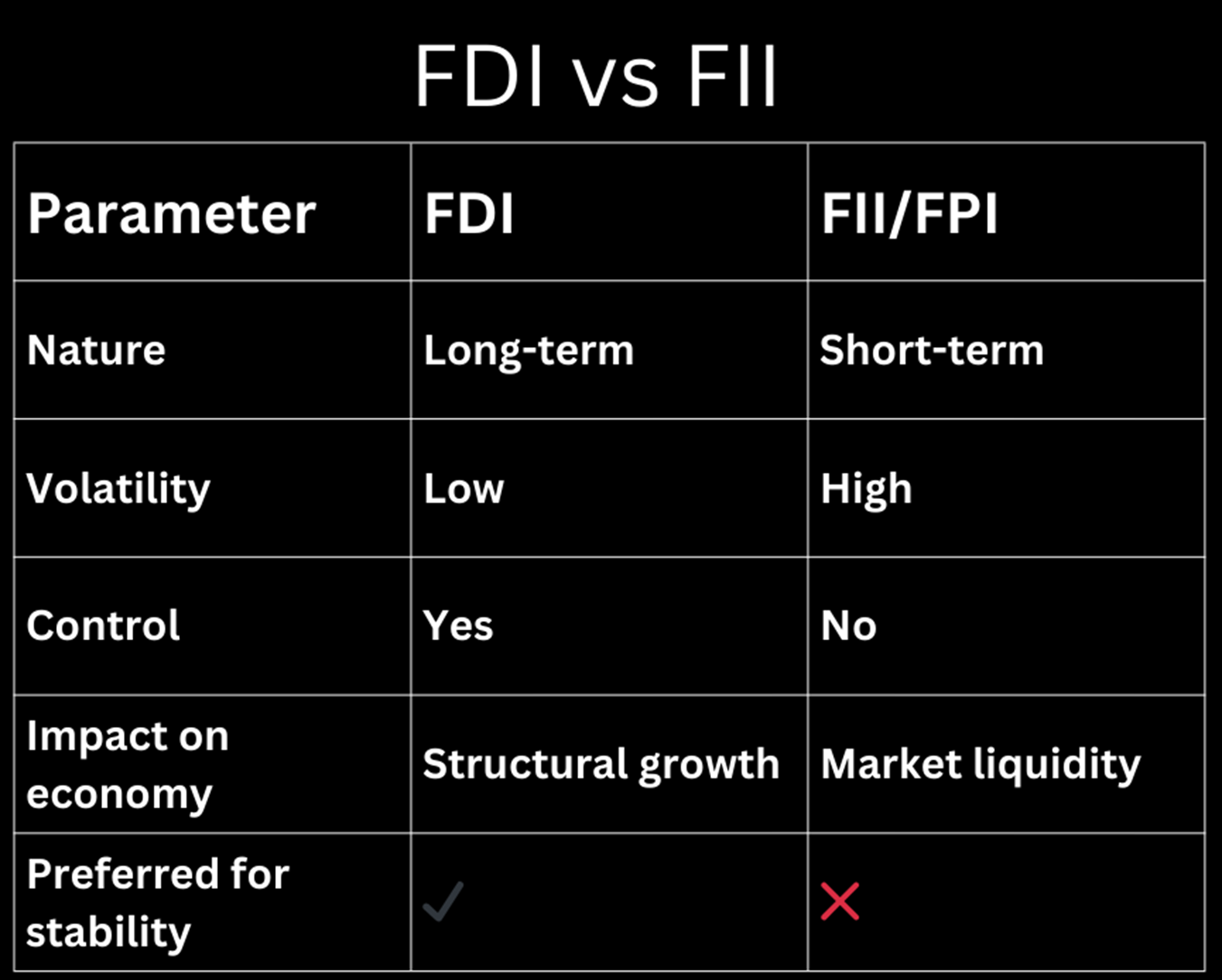
FDI refers to long-term investment where a foreign entity invests in India with an intention to establish a lasting interest and control (generally 10% or more equity stake).
Characteristics:
- Stable, long-term capital
- Involves technology transfer
- Creates employment and infrastructure
- Less volatile during global financial shocks
Examples:
- A foreign company opening a manufacturing plant in India
- Strategic stake acquisitions like Walmart in Flipkart
Foreign Institutional Investment (FII / FPI)
FII is short-term capital investment in Indian financial markets (stocks, bonds) by foreign investors.
Characteristics:
- Highly liquid and volatile
- Quickly responsive to global sentiments
- Doesn’t create assets directly
- Supports financial market depth and liquidity
Examples:
- Global hedge funds investing in Nifty stocks
Foreign entities purchasing government bonds
2. FEMA — The Legal Framework Governing Foreign Exchange
The Foreign Exchange Management Act (FEMA), 1999 replaced FERA to facilitate a more liberal, transparent, and investment-friendly environment.
Key Features of FEMA
- Encourages external trade and payments
- Manages all foreign exchange transactions
- Defines capital vs. current account transactions
- Empowers RBI to regulate foreign currency flows
- Civil law (unlike criminal-oriented FERA)
Why FEMA Matters in FDI–FII Context
- All FDI and FII inflows must comply with FEMA regulations
- FEMA ensures investors follow investment caps, sectoral limits, and reporting requirements
- RBI uses FEMA provisions to control capital flight and regulate foreign borrowing
For UPSC Mains, FEMA is crucial in discussions on capital account convertibility, external sector stability, and Indian monetary policy.
3. Current Account Deficit (CAD) — A Persistent External Sector Concern
The Current Account of India’s Balance of Payments records trade in goods, services, income, and transfers.
When imports exceed exports, India faces a Current Account Deficit.
Why CAD Matters
A high CAD indicates:
- Excessive reliance on imports
- Lower competitiveness of domestic industries
- Need for external financing (FDI/FII inflows)
CAD is directly linked with India’s external sector management and macroeconomic stability.
Major Drivers of CAD in India
- High crude oil and gold imports
- Weak merchandise exports
- Slowdown in IT and service exports
- Global trade tensions
4. Interlinkages: FDI, FII, FEMA & CAD
(a) FDI and CAD
FDI helps bridge the CAD because:
- It brings stable capital
- Supports export-oriented industries
- Reduces pressure on foreign exchange reserves
Thus, India encourages FDI through automatic routes and sectoral reforms.
(b) FII and CAD
FII inflows finance CAD but carry risks:
- They can evaporate during global uncertainty (e.g., Fed rate hikes)
- Sudden outflows widen CAD and depreciate the rupee
- Volatility impacts stock and bond markets
Hence, while useful, FII cannot be the primary CAD-financing mechanism.
(c) FEMA’s Role
FEMA acts as India’s external sector guardrail:
- Regulates foreign capital inflows and outflows
- Prevents unchecked foreign borrowing
- Ensures orderly development of forex markets
- Monitors capital account transactions to prevent CAD deterioration
Thus, FEMA ensures India’s external stability while promoting investment.
5. UPSC Mains-Driven Insight: Why Stable Capital Is Critical for India
India’s growth model is investment-heavy. To maintain 7–8% GDP growth, India needs:
- Stable long-term capital → FDI
- Managed short-term capital → FII
- Strong regulatory framework → FEMA
- Controlled external imbalance → Low CAD
FDI is the most preferred as it:
- Strengthens the rupee
- Boosts productivity
- Reduces dependence on volatile foreign capital
- Supports export competitiveness
Conclusion
For IAS aspirants, the interplay between FDI, FII, FEMA, and CAD reflects India’s broader economic management strategy.
- FDI fuels structural growth,
- FII boosts market liquidity but adds volatility,
- FEMA provides regulatory discipline, and
- CAD shows India’s external vulnerability.