

Learn about Fiscal Policy, its objectives, types, and instruments for UPSC CSE. Complete UPSC Economics notes by Vijetha IAS Academy. Covers Fiscal Deficit, FRBM Act, and Budget Concepts in detail.
Introduction: What is Fiscal Policy?
Fiscal Policy refers to the use of government expenditure and revenue (mainly taxation) to influence a country’s economy.
It is one of the key tools through which the Government of India manages economic growth, inflation, employment, and income distribution.
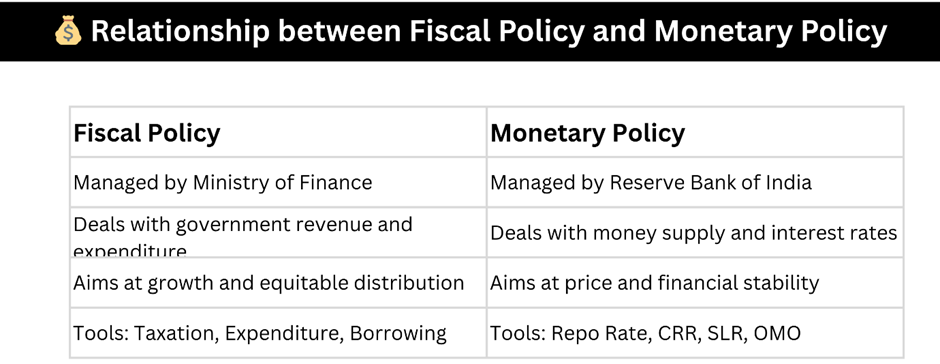
While monetary policy is handled by the Reserve Bank of India (RBI), fiscal policy is managed by the Ministry of Finance.
Both work together to maintain macroeconomic stability.
Definition of Fiscal Policy
Fiscal Policy is the government’s policy regarding taxation, expenditure, borrowing, and deficit management to achieve desired levels of economic activity and growth.
In simple terms, it decides how the government earns money (revenue) and how it spends it (expenditure).
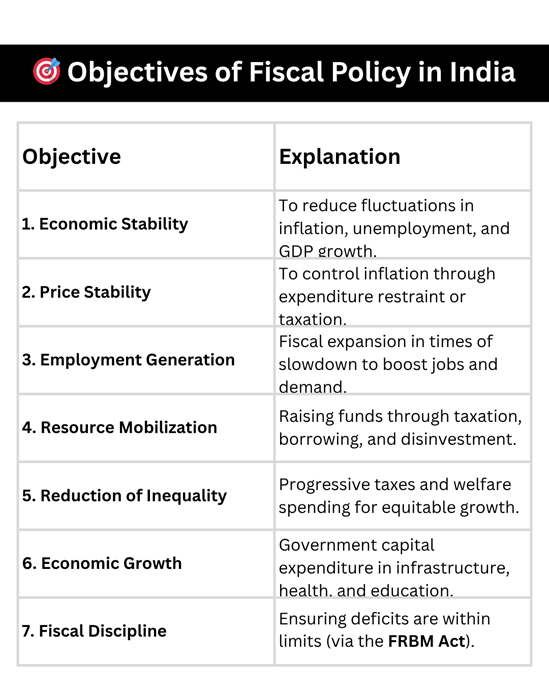
📈 Fiscal Deficit and Its Importance
Fiscal Deficit = Total Expenditure – (Revenue Receipts + Non-debt Capital Receipts)
It represents the total borrowing requirement of the government in a financial year.
A moderate deficit promotes growth, but a high deficit can cause inflation, crowding-out of private investment, and fiscal instability.
Fiscal Responsibility and Budget Management (FRBM) Act
- Enacted in 2003 to maintain fiscal discipline.
- Sets targets for reducing fiscal and revenue deficits.
- Aims to achieve inter-generational equity and macroeconomic stability.
- The FRBM Review Committee (N.K. Singh, 2017) suggested a fiscal deficit target of 3% of GDP.
Challenges in India’s Fiscal Policy
- High Fiscal Deficit and Public Debt
- Subsidy Burden on food, fuel, and fertilizer
- Tax Evasion and Narrow Tax Base
- Low Capital Expenditure Ratio
- State-level Fiscal Imbalances
- Populist Policies affecting fiscal prudence
Frequently Asked Questions (UPSC-Oriented FAQs)
Q1. What is the difference between Fiscal Deficit and Revenue Deficit?
➡️ Fiscal deficit includes both revenue and capital expenditures, while revenue deficit covers only current income and spending.
Q2. Who formulates fiscal policy in India?
➡️ The Ministry of Finance, particularly the Department of Economic Affairs, formulates fiscal policy.
Q3. What is counter-cyclical fiscal policy?
➡️ It means increasing spending during slowdowns and cutting it during booms — to stabilize the economy.
🏁 Conclusion
Fiscal Policy is the backbone of India’s economic management. It plays a crucial role in achieving growth, stability, equity, and sustainability.
For UPSC aspirants, understanding fiscal policy concepts — along with the Budget, FRBM Act, and Public Finance basics — is essential for both Prelims and Mains.