
Development indicators are essential tools used to evaluate the overall progress and well-being of nations. They move beyond traditional economic measures like GDP and provide a multidimensional picture of how people live, what opportunities they have, and how effectively governments deliver social, economic, and environmental development. Indices such as the Human Development Index (HDI), Multidimensional Poverty Index (MPI), Gender Development Index (GDI), Human Capital Index (HCI), Global Hunger Index (GHI), and several others are widely used by global institutions to assess comparative performance and identify critical areas requiring policy attention. These indicators capture complexities such as health standards, educational outcomes, poverty levels, inequality, innovation, environmental performance, and overall quality of life, helping nations understand where they stand and how development can be made more inclusive and sustainable.
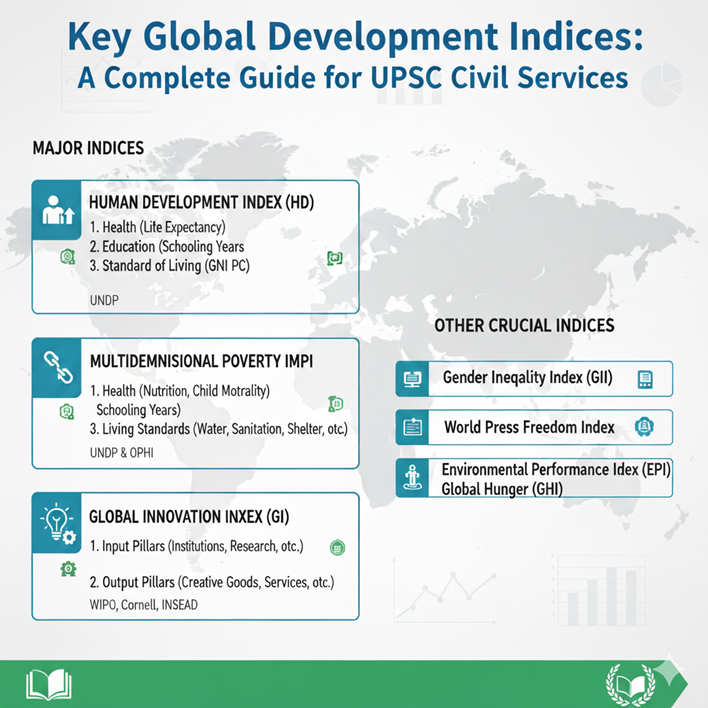
🔹 1. Human Development Index (HDI)
Published by: United Nations Development Programme (UNDP) in its Human Development Report.
Purpose: Measures overall achievement in key dimensions of human development.
HDI Components
- Health – Life expectancy at birth
- Education –
- Mean years of schooling
- Expected years of schooling
- Standard of Living – GNI per capita (PPP)
What HDI Indicates
HDI reflects how well a country transforms its economic growth into tangible social development. Higher HDI signifies better access to education, healthcare, and income.
UPSC Relevance
- HDI trends on global inequality
- India's position vis-à-vis South Asian neighbours
- Policy recommendations in GS Paper 2 & GS Paper 3
🔹 2. Multidimensional Poverty Index (MPI)
Published by: UNDP and Oxford Poverty & Human Development Initiative (OPHI)
Purpose: Measures poverty based on multiple deprivations, not just income.
MPI Indicators
MPI covers 10 indicators grouped under 3 dimensions:
A. Health
- Nutrition
- Child mortality
B. Education
- Years of schooling
- School attendance
C. Standard of Living
- Cooking fuel
- Sanitation
- Drinking water
- Electricity
- Housing
- Assets
Why MPI Matters
It reveals pockets of interlinked poverty and helps governments design targeted welfare programs.
UPSC Relevance
- NITI Aayog publishes India’s national MPI
- Important for welfare schemes, social sector analysis, and SDG tracking
🔹 3. Gender Development Index (GDI)
Published by: UNDP
Focus: Measures gender gaps in human development in the same dimensions as HDI.
UPSC Angle
Helps explain gender inequality trends in GS 1 & GS 2.
🔹 4. Gender Inequality Index (GII)
Published by: UNDP
Components:
- Reproductive health
- Empowerment
- Labour force participation
It highlights structural gender-based disadvantages.
UPSC Angle
Useful for essay, GS1 (Society), and GS2 (Governance).
🔹 5. Global Hunger Index (GHI)
Published by: Concern Worldwide and Welthungerhilfe
Indicators
- Undernourishment
- Stunting
- Wasting
- Child mortality
UPSC Angle
Frequently in news; India’s ranking often debated politically.
🔹 6. Human Capital Index (HCI)
Published by: World Bank
Measures a country's capability to develop human resources through health and education.
UPSC Angle
Important for inclusive development, demographic dividend discussions.
🔹 7. World Happiness Report
Published by: Sustainable Development Solutions Network (SDSN)
Factors Considered
- Social support
- Freedom
- Corruption perception
- Life expectancy
- Income
- Generosity
UPSC Angle
Emerging global metric reflecting non-economic well-being.
🔹 8. Global Competitiveness Index (GCI)
Published by: World Economic Forum (WEF)
Assesses:
- Infrastructure
- Institutions
- Macroeconomic stability
- Innovation capability
🔹 9. Global Innovation Index (GII)
Published by: WIPO
Measures innovation ecosystem, research output, and technological progress.
🔹 10. Environmental Performance Index (EPI)
Published by: Yale & Columbia Universities
Assesses environmental health, air quality, climate policy, and biodiversity.
🌐 Why Development Indices Matter for UPSC Aspirants
1. Prelims
- Direct factual questions on publishers, indicators, ranking methodology.
2. Mains
- Used to substantiate arguments in essays and GS papers.
- Helps analyze development challenges, inequality, and welfare policy design.
3. Interview
- Useful for discussing India’s socio-economic performance and global benchmarks.
Conclusion
HDI, MPI, and other development indices go beyond economic output and measure the actual quality of human life in a society. For future civil servants, understanding these indices is essential for policy analysis, developmental planning, and governance. They not only prepare you for the UPSC exam but also build a broader understanding of what meaningful development truly means.