
India is living through one of the most intense phases of infrastructure creation since Independence. What once felt like disconnected upgrades — a power plant here, a road there, a handful of telecom towers — is now unfolding as a synchronized nationwide overhaul. The guiding philosophy is simple: economic growth follows infrastructure, and the faster India builds, the more competitive and inclusive its growth becomes.
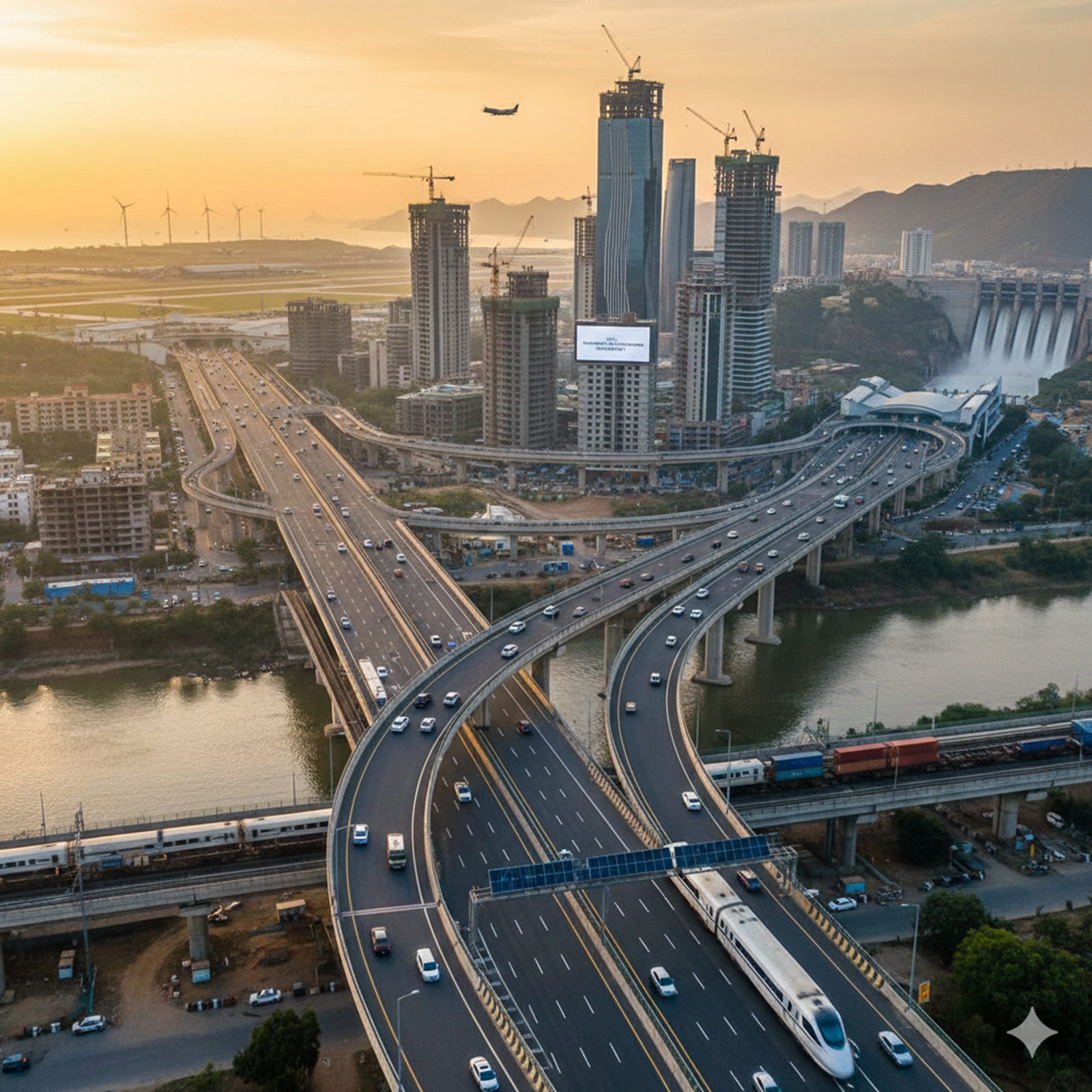
Just in the last few years, India has repositioned infrastructure as the backbone of its development model. With the National Infrastructure Pipeline (NIP) laying out a massive multi-sector investment vision up to 2025, and the PM Gati Shakti National Master Plan ensuring ministries and states coordinate rather than work in silos, infrastructure is no longer just spending — it is strategy. Every new power line, highway, railway station and submarine cable is now planned to plug directly into a larger logistics and economic grid supporting the road to a $5 trillion economy.
Energy: from supply gaps to sustainable strength
The energy landscape has evolved from a struggle to meet demand to a race to diversify and decarbonize. Renewable capacity additions — especially solar — have expanded dramatically, while thermal additions have slowed visibly since 2023–24, signalling a structural shift rather than a temporary trend. The push toward rooftop solar, EV-charging infrastructure, and urban micro-grids shows that cities are becoming active energy producers, not just consumers. Reliable energy is now seen not only as a comfort for households but as the fuel for industry, logistics and digital services — all pillars of modern competitiveness.
Transport: stitching the nation into a connected economic zone
Transport infrastructure has entered a phase of scale and speed previously unseen.
- Indian Railways now extends almost 68,000 km of broad gauge across 7,300+ stations, and the electrification drive has covered over 80% of the network, sharply cutting fuel dependence and emissions.
- The Amrit Bharat Station Scheme (ABSS) is modernising more than 1,200 stations, focusing on passenger comfort, commercial spaces, and local economic integration — a transformation that will be felt daily by millions.
- On the road front, national expressways, economic corridors and ring-road systems under Bharatmala are steadily reducing transit time and logistics cost — a game changer for exports and supply chains.
- Meanwhile, Sagarmala has been reshaping coastal and inland waterways, accelerating port-led industrialization and improving India’s maritime competitiveness.
The cumulative effect is that movement across India — of people, goods and services — is becoming faster, cheaper and safer, and that reshapes the economic geography of the country.
Communication: the invisible architecture of modern growth
For decades, infrastructure meant cement and steel. Today, communication infrastructure is equally critical. With high-speed broadband, expanding fiber networks and digital governance platforms reaching deep into rural India, communication networks have become the “pipes” for the knowledge economy. What roads were to trade in the industrial era, communication networks are to mobility, learning, finance and entrepreneurship today.
Because of this, communication has been woven into national infrastructure planning — not as an add-on, but as a core pillar of productivity and inclusion. Whether it is remote education, telemedicine, digital logistics or direct benefit transfers, India’s development model increasingly runs on bandwidth.
A new development logic
Energy powers factories and households.
Transport moves people, goods and opportunities.
Communication connects ideas, services and markets.
Individually, they matter — collectively, they transform a nation.
India’s current infrastructure push is not about grand structures alone; it is about shaping an environment where industry thrives, logistics become globally competitive, renewable energy reduces vulnerability to imports, and digital access ensures every citizen can participate in growth.
The outcome is already visible: lower logistics costs, improved quality of life, better investment climate and rising regional balance in development. In simple terms, infrastructure is no longer supporting growth — it is driving it.
✅ ENERGY — PRELIMS RELEVANT FACTS
🔹 Installed power capacity in India → dominated by thermal power, followed by renewable energy, then hydro, then nuclear.
🔹 Coal continues to be the major source of electricity generation in India.
🔹 India is the 3rd-largest producer of renewable energy in the world (after China & USA).
🔹 Solar is the fastest-growing renewable source in India.
🔹 Green Hydrogen Mission aims to make India a global hydrogen hub.
🔹 Smart Grids → integrate digital tech to balance electricity demand and supply in real time.
🔹 DISCOMs (Distribution Companies) are the weakest link in the Indian power sector due to financial stress.
🔹 Hydropower potential is high in Himalayan & North-Eastern regions.
🔹 Nuclear power forms a small share of India’s energy mix, but provides reliable baseload.
🔹 Peak electricity demand rises every year due to urbanization & industry growth.
🔹 Energy storage (battery + pumped hydro) is critical for high renewable usage.
🔹 India imports most of its crude oil → energy security challenge.
🚆 TRANSPORT — PRELIMS RELEVANT FACTS
🔹 Roads carry the highest share of passenger & freight traffic in India.
🔹 National Highways form less than 3% of total roads but carry over 40% of road traffic.
🔹 Railways are the largest carrier of freight after roads, especially bulk commodities (coal, cement, fertilizers).
🔹 Railways are switching to 100% electrification (mission mode).
🔹 Dedicated Freight Corridors (DFCs) → designed mainly for long-haul freight movement.
🔹 Sagarmala Programme → port modernization + coastal shipping + inland waterways.
🔹 Bharatmala Programme → economic corridors + expressways + border connectivity.
🔹 UDAN Scheme → regional air connectivity.
🔹 Water transport has the lowest cost per tonne-km → energy-efficient mode.
🔹 Air transport has the highest cost per passenger-km but is fastest.
🔹 Logistics cost in India is higher than global average → reform priority.
🌐 COMMUNICATION — PRELIMS RELEVANT FACTS
🔹 Telecom & Internet form the core of modern communication infrastructure.
🔹 Fibre optic cables enable highest-speed data transmission.
🔹 Satellites enable communication in remote areas where fiber is not feasible.
🔹 India has one of the largest telecom subscriber bases in the world.
🔹 Digital public infrastructure (DPI) → includes Aadhaar, UPI, DigiLocker, etc.
🔹 BharatNet aims to connect all gram panchayats to high-speed broadband.
🔹 5G supports ultra-low latency + IoT + autonomous systems.
🔹 Cybersecurity is a critical concern in communication networks.
🔹 Digital divide persists — urban areas have higher quality access than rural areas.
🔹 Broadcasting includes radio, TV, and digital streaming.
🔹 Communication satellites operate in different orbits (LEO, MEO, GEO) for different purposes.