
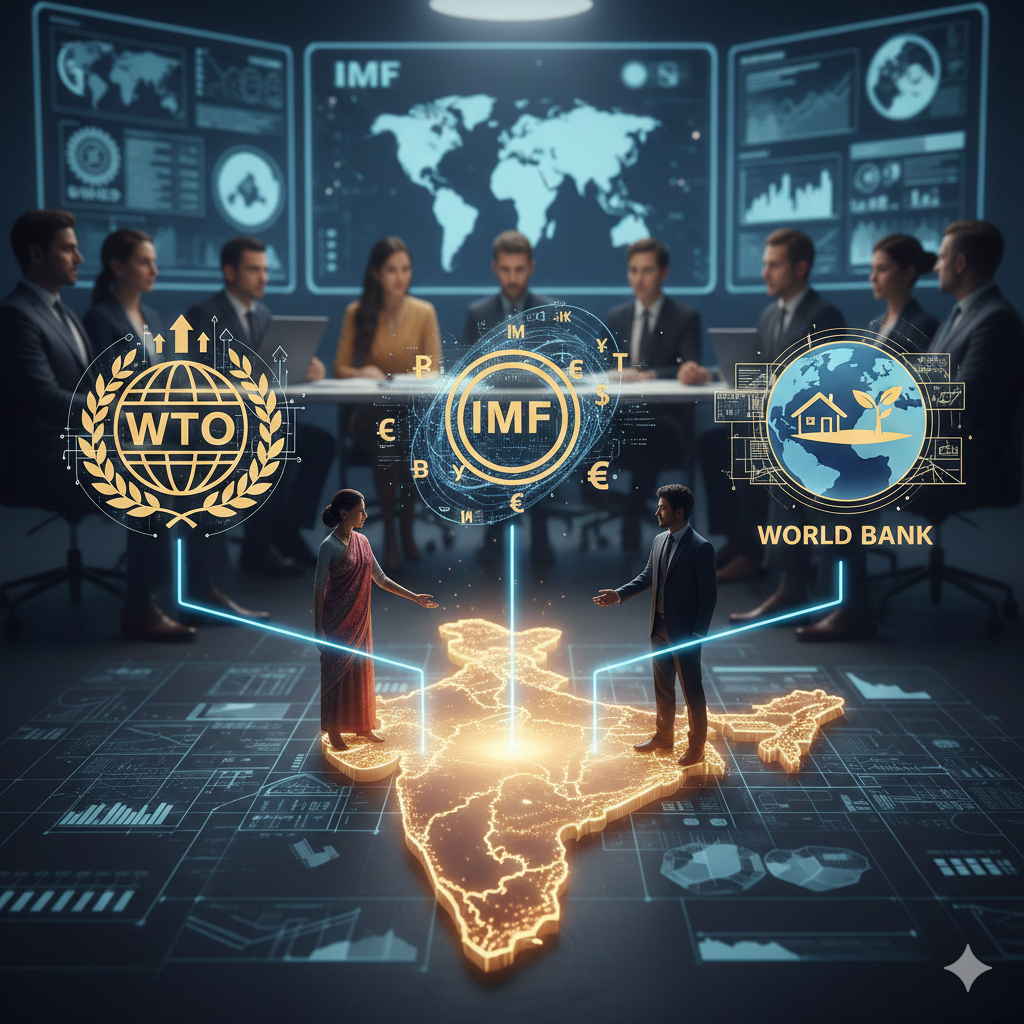
India’s relationship with global economic institutions such as the World Trade Organization (WTO), International Monetary Fund (IMF) and the World Bank has steadily evolved from post-independence dependence to strategic participation. These institutions influence how India trades with the world, manages financial stability and finances long-term development. Understanding this engagement helps explain India’s position in the global economy and its approach to multilateral cooperation.
India and the World Trade Organization (WTO)
The World Trade Organization came into force in 1995 with the aim of creating a predictable and rules-based global trading system. India, as a founding member, has consistently supported multilateral trade while defending the interests of developing economies.
India is a founding member of the WTO (1995)
A major focus of India’s engagement has been agriculture and food security. India’s public procurement and food distribution systems support millions of vulnerable households and are central to national food security. At global trade negotiations, India has argued that such programmes should not be constrained by outdated subsidy limits. This approach reflects India’s broader effort to ensure that global trade rules accommodate development needs.
WTO is headquartered in Geneva, Switzerland
India has also actively participated in discussions on intellectual property rights, services trade and digital commerce. During global health emergencies, India has emphasized the need for flexible intellectual property norms to ensure affordable access to medicines. These positions underline India’s attempt to balance open trade with social and developmental priorities.
Trade integration through the WTO framework has helped India expand its presence in global markets. Over the years, India has diversified exports beyond traditional goods to include pharmaceuticals, information technology services and engineering products, strengthening its role in global value chains.
India supports the public stockholding of food grains under WTO rules.
India and the International Monetary Fund (IMF)
The International Monetary Fund was created to promote global monetary cooperation and financial stability. India joined the IMF in 1945 and for several decades relied on it for balance-of-payments support during periods of external stress.
A defining moment in this relationship came during the early 1990s, when India undertook major economic reforms after facing a severe foreign exchange crisis. Since then, India’s macroeconomic position has strengthened considerably. Today, India is no longer a borrower but a contributor to IMF resources, reflecting its improved economic resilience.
The Agreement on Agriculture (AoA) is a key concern for India.
India also plays an active role in discussions on reforming IMF governance structures. It has consistently advocated for greater representation of emerging and developing economies, arguing that global financial institutions must reflect contemporary economic realities rather than post-war power structures.
IMF assessments and economic forecasts frequently influence global perceptions of India’s growth prospects, fiscal discipline and monetary policy credibility. These evaluations shape investor confidence and reinforce India’s image as a stable and fast-growing economy.
India is part of the G-33 group at the WTO.
India and the World Bank
The World Bank’s engagement with India focuses on long-term development and institutional capacity building. Since joining in 1944, India has been one of the Bank’s largest partners, using its support to address structural development challenges.
World Bank assistance has played a key role in areas such as rural livelihoods, health systems, sanitation, urban infrastructure and education. Over time, the partnership has shifted from funding large standalone projects to supporting policy reforms, state-level initiatives and outcome-based programmes.
WTO deals with trade in goods, services, and intellectual property.
In recent years, cooperation has expanded into climate resilience, renewable energy and disaster-risk management. These efforts align with India’s broader development goals, including sustainable growth and environmental protection. The World Bank’s analytical reports and technical expertise also contribute to evidence-based policymaking in India.
At the same time, India has increasingly emphasized the need for reforms in World Bank leadership and decision-making processes, advocating for a more inclusive and representative global development architecture.
India frequently uses the WTO Dispute Settlement Mechanism.
India’s Broader Multilateral Approach
Across the WTO, IMF and World Bank, India’s engagement reflects a common theme: supporting multilateralism while seeking reforms that recognize the realities of developing and emerging economies. India participates actively in rule-making, coalition-building and institutional reform discussions rather than remaining a passive stakeholder.
This approach allows India to protect domestic priorities, influence global economic norms and strengthen its role in shaping international economic governance. As India’s economic weight continues to rise, its voice within these institutions is likely to become even more significant.
Conclusion
India’s relationship with the WTO, IMF and World Bank illustrates its journey from a newly independent economy to a confident global player. These institutions continue to shape India’s trade policies, financial stability and development pathways, while India, in turn, seeks to reshape them to be more equitable and representative. This dynamic engagement remains a cornerstone of India’s interaction with the global economic system.