

Understanding the voting process for MLA elections is essential for UPSC CSE preparation, especially for topics related to Polity, Governance, and Electoral Systems. The election of Members of the Legislative Assembly (MLAs) forms the foundation of India’s democratic and federal structure. This guide by Vijetha IAS Academy provides a clear, structured, and exam-oriented explanation that helps aspirants master this topic for both Prelims and Mains.
What Is an MLA Election? (UPSC Perspective)
A Member of the Legislative Assembly (MLA) represents a specific constituency within a state. MLA elections are conducted by the Election Commission of India (ECI) under the provisions of the Representation of the People Act, 1951. These elections determine the composition of the State Legislative Assembly, which plays a crucial role in legislation and governance at the state level.
Constituencies and Voter Eligibility
1. State Legislative Assembly Constituencies
Each state is divided into single-member constituencies, and each constituency elects one MLA through a direct election.
2. Who is Eligible to Vote?
A person can vote in MLA elections if they:
- Are an Indian citizen
- Are 18 years or older
- Are registered in the constituency’s electoral roll
- Are not disqualified under any law
Step-by-Step Voting Process for MLA Elections
Step 1: Announcement of Election Schedule
The ECI announces the election dates, phases, and the enforcement of the Model Code of Conduct (MCC).
Step 2: Nomination of Candidates
Candidates submit nomination papers. Scrutiny of nominations and the period for withdrawal follow as per ECI guidelines.
Step 3: Campaigning Period
Political parties and candidates campaign through rallies, media campaigns, and door-to-door outreach.
Campaigning must stop 48 hours before polling (known as the “silent period”).
Step 4: Preparation of Polling Stations
Polling booths are set up to ensure:
- Smooth conduct of voting
- Security arrangements
- Availability of EVMs and VVPATs
- Accessibility for senior citizens and persons with disabilities
Step 5: Polling Day – How Voting Actually Happens
a. Voter Identification
Voters verify their identity using documents such as:
- Voter ID (EPIC)
- Aadhaar (where permitted)
- Passport
- PAN Card
- Driving License
- Other ECI-approved documents
b. Verification and Indelible Ink Marking
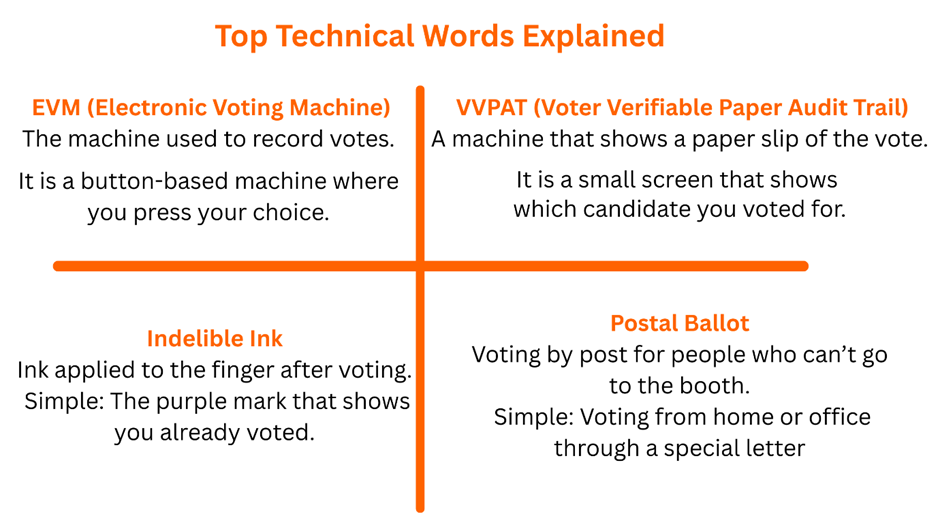
Election officials confirm the voter’s name in the electoral roll and apply indelible ink to prevent duplicate voting.
c. Voting Using EVMs
- The presiding officer activates the Control Unit
- The voter presses the button corresponding to their chosen candidate on the Ballot Unit (EVM)
- The vote is instantly recorded electronically
d. VVPAT Slip Display
The VVPAT (Voter Verifiable Paper Audit Trail) generates a slip showing the voter’s selection for about 7 seconds, ensuring transparency and trust in the system.
Step 6: Sealing and Transporting EVMs
After polling ends, EVMs and VVPATs are sealed and transported to secure strong rooms with CCTV surveillance and guards.
Step 7: Counting of Votes
- Counting begins with postal ballots
- EVM results are then compiled
- VVPAT slips from randomly selected booths are matched as per ECI rules
Step 8: Declaration of Results
The candidate who secures the highest number of valid votes is declared elected as the MLA of that constituency.
Measures Ensuring Transparency and Fairness
- Use of EVM + VVPAT technology
- Multi-layer security at polling stations
- Presence of polling agents from various parties
- Strict adherence to electoral laws and MCC
- Continuous monitoring by ECI officials
These features make the MLA election process transparent and reliable, a key aspect often asked in UPSC GS-II.
Importance of MLA Elections – For UPSC CSE
MLAs play a crucial role in:
- Law-making at the state level
- State budget approval
- Oversight of the executive
- Electing members to the Rajya Sabha
Hence, understanding the electoral process is essential for UPSC Prelims, Mains (GS-II), and Interview.
Conclusion
The MLA election voting process is a cornerstone of India’s democratic structure. A clear understanding of each stage—from nomination to counting—is essential for UPSC aspirants. This detailed guide by Vijetha IAS Academy ensures a solid grasp of this important topic, improving both conceptual clarity and exam readiness.
Try to solve this :
Q1.
With reference to the VVPAT system, consider the following statements:
- The VVPAT slip is automatically stored in a sealed box and is not accessible to the presiding officer.
- The ECI mandates VVPAT counting in at least five randomly selected polling stations per Assembly Constituency.
- VVPAT slips can be counted even without a court or ECI order if a candidate demands it.
Which of the statements is/are correct?
A. 1 and 2 only
B. 2 only
C. 1 and 3 only
D. 1, 2 and 3
Q2.
Under the Representation of the People Act, 1951, which of the following is a ground for post-election disqualification of a winning candidate?
A. Holding an office of profit under the State Government
B. Failure to lodge election expenses within prescribed time
C. Contempt of court
D. Being declared insolvent