

Introduction
Sikhism is one of the youngest major religions in the world, founded in the 15th century CE in the Punjab region of India. It emphasizes monotheism, equality, justice, and service to humanity. The teachings of Sikhism are vital for UPSC aspirants studying Indian History, Culture, and Ethics (GS Paper IV).
Origin and Historical Background
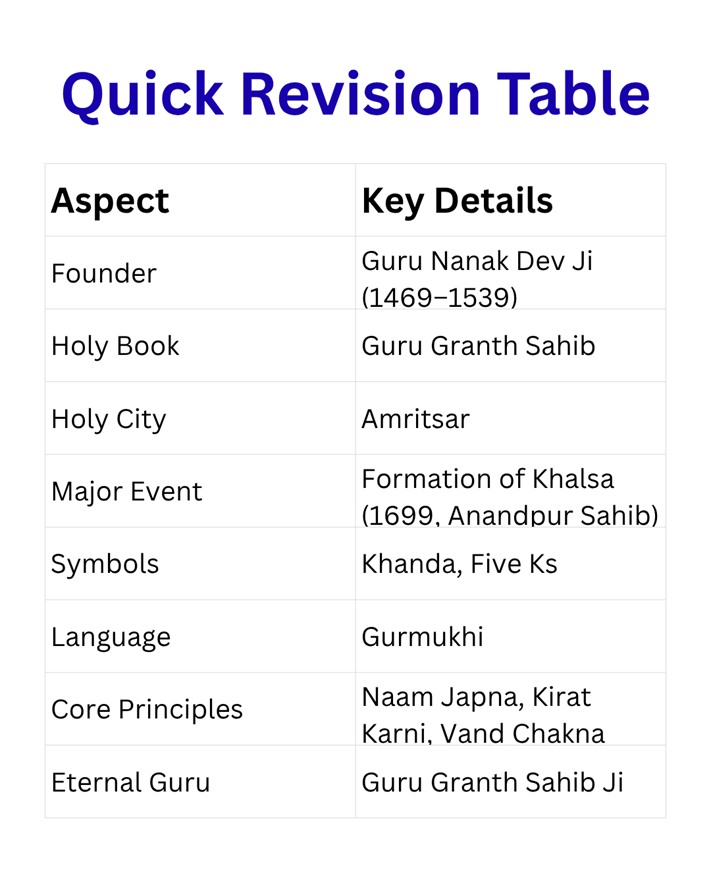
Sikhism originated as a spiritual and social reform movement during the late 15th century CE. It was founded by Guru Nanak Dev Ji (1469–1539), who preached against caste divisions, ritualism, and religious intolerance.
After Guru Nanak, the Sikh faith evolved under nine successive Gurus, culminating in the Guru Granth Sahib, which was declared the eternal Guru by Guru Gobind Singh Ji in 1708.
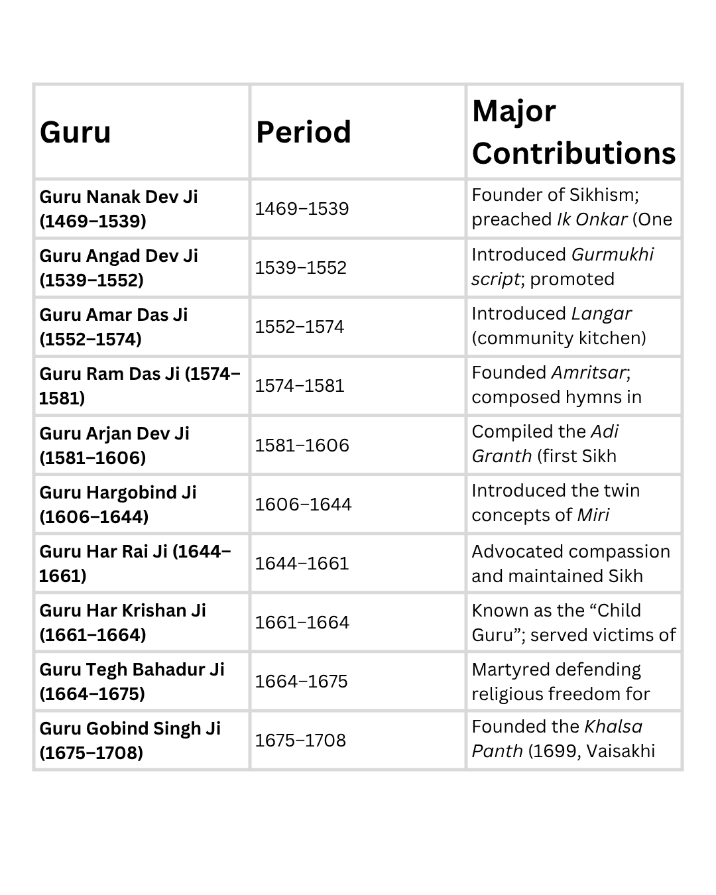
Ten Sikh Gurus and Their Contributions
Core Beliefs and Principles of Sikhism
- Monotheism (Ik Onkar):
Belief in one formless, eternal, and all-pervading God. - Equality of Humanity:
Rejection of caste, gender, and religious discrimination. - Three Pillars of Sikhism (Teachings of Guru Nanak):
- Naam Japna: Meditation on God’s name.
- Kirat Karni: Earning an honest living.
- Vand Chakna: Sharing with others and serving the needy.
- Community Service (Seva):
Selfless service for humanity, reflected in Langar. - Rejection of Ritualism:
No idol worship, blind rituals, or superstition.
The Khalsa and Its Significance
The Khalsa Panth was formally established by Guru Gobind Singh Ji on Vaisakhi (13 April 1699) at Anandpur Sahib.
He initiated five Sikhs — the Panj Pyare — symbolizing courage, equality, and sacrifice. The Khalsa stands for discipline, moral strength, and spiritual purity.
The Five Ks (Panj Kakars):
- Kesh – Uncut hair
- Kangha – Wooden comb
- Kachera – Short breeches (symbol of chastity)
- Kara – Steel or iron bracelet (discipline and restraint)
- Kirpan – Sword (symbol of justice and courage)
Significance:
- Men take the name Singh (Lion); women take Kaur (Princess).
- The Khalsa represents unity, equality, and readiness to fight oppression.
Sacred Scripture and Symbols
- Guru Granth Sahib:
The holy scripture and eternal Guru of Sikhs, containing hymns (Shabads) of Sikh Gurus and saints from Hindu and Muslim traditions. - Language: Written in Gurmukhi script, primarily in Punjabi.
- Symbol: The Khanda — a double-edged sword with a circular Chakkar and two single-edged swords — represents divine knowledge, justice, and unity.
Sacred Shrines and Institutions
- Harmandir Sahib (Golden Temple):
Located in Amritsar; the holiest Sikh shrine and symbol of equality and brotherhood. - Five Takhts (Seats of Authority):
- Akal Takht Sahib – Amritsar, Punjab
- Takht Sri Kesgarh Sahib – Anandpur Sahib, Punjab
- Takht Sri Damdama Sahib – Talwandi Sabo, Punjab
- Takht Sri Patna Sahib – Patna, Bihar
- Takht Sri Hazur Sahib – Nanded, Maharashtra
Sikhism and Society
Sikhism emerged as a spiritual-social movement challenging caste, ritualism, and inequality.
It promoted:
- Social justice and equality for all
- Women’s empowerment and dignity
- Religious tolerance and pluralism
- Collective community welfare (Sarbat da Bhala)
Its teachings have deeply influenced India’s reform movements, freedom struggle, and the national ethos of secularism and inclusivity.
Sikhism in the Modern Context
- The Shiromani Gurdwara Parbandhak Committee (SGPC) manages Sikh shrines and institutions.
- Sikhism has a strong global presence, with major communities in Canada, the UK, and the U.S.
- Its values of sewa (service) and sarbat da bhala (welfare of all) continue to inspire humanitarian and community initiatives worldwide.
Conclusion
Sikhism stands as a beacon of faith, equality, and service. Its core message — “Ik Onkar”, the oneness of God and humanity — remains deeply relevant in today’s world. For IAS aspirants, studying Sikhism provides key insights into India’s composite culture, ethical traditions, and socio-religious reform movements, which are indispensable for UPSC Prelims, Mains, and Essay papers.