

Understand the US HIRE Bill (Halting International Relocation of Employment Act) 2025 — its key provisions, objectives, impact on Indian outsourcing and IT industry, and UPSC-relevant analysis.
Introduction: What is the US HIRE Bill?
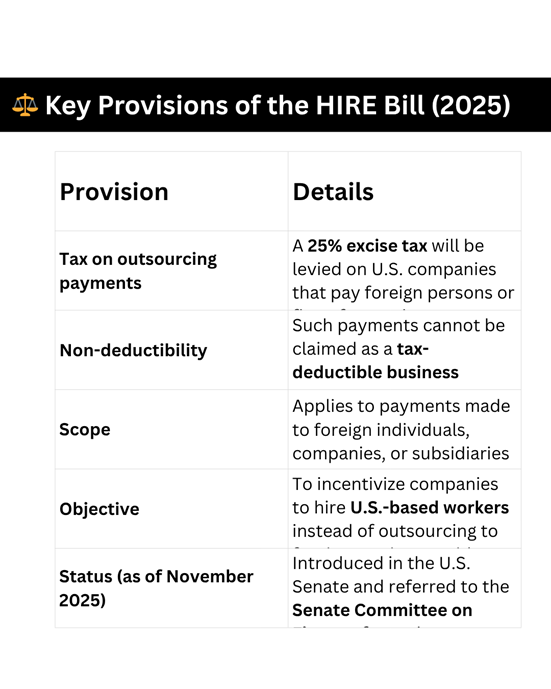
In October 2025, a new legislation titled the Halting International Relocation of Employment Act (HIRE Bill) was introduced in the United States Senate. The bill seeks to discourage outsourcing of jobs and services by imposing a 25% tax on U.S. companies that make payments to foreign workers or foreign service providers.
Proposed by Senator Bernie Moreno (Ohio), the bill aims to protect American jobs and encourage domestic employment, but it has triggered serious concerns in global markets — particularly in India, where the IT and BPO sectors depend heavily on U.S. outsourcing contracts.
For UPSC aspirants, this bill provides a real-world example of economic protectionism, globalization challenges, and India–US trade relations — all crucial for GS Paper 2 and GS Paper 3.
Rationale Behind the Bill
The HIRE Bill is rooted in domestic political and economic priorities in the United States:
- Rising unemployment and economic slowdown have renewed calls for “America First” policies.
- Lawmakers argue that outsourcing reduces domestic job opportunities and wage growth.
- By taxing outsourced payments, the U.S. government seeks to make domestic hiring more attractive for companies.
However, experts warn that such protectionist measures may backfire by increasing costs for American firms, especially in tech and financial services, which depend on cost-efficient global talent.
Impact on India and the Global Outsourcing Industry
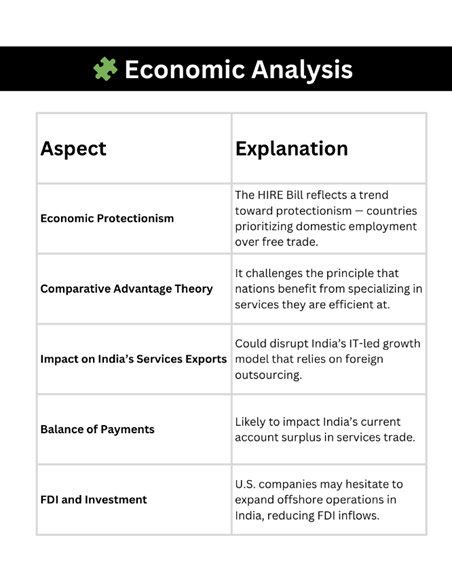
India’s economy is highly integrated with global service exports. The IT, BPO, and consulting sectors collectively contribute nearly 8% of India’s GDP, employing millions and earning over $250 billion annually — with nearly 60% of this revenue from the U.S. market.
Potential Impacts:
- Revenue Loss for Indian IT Companies
Major Indian firms like TCS, Infosys, Wipro, and HCL may see reduced demand from U.S. clients due to higher tax burdens on outsourcing. - Reduced Foreign Exchange Inflows
A decline in U.S. outsourcing could weaken India’s current account balance and rupee stability. - Shift in Global Service Models
U.S. firms may move towards nearshoring (outsourcing to nearby countries like Mexico or Canada) or onshoring (within the U.S.), reshaping global labor patterns. - Impact on Employment in India
The bill may affect white-collar employment, especially in Tier-1 cities like Bengaluru, Hyderabad, and Pune, which host global capability centers (GCCs). - Diplomatic and Trade Repercussions
The bill could become a trade irritant in India–US relations, prompting India to seek discussions through bilateral or WTO channels.
Diplomatic & Policy Implications for India (GS Paper 2)
- India may engage in economic diplomacy with the U.S. to safeguard outsourcing interests.
- Strengthening bilateral trade agreements or negotiating tax exemptions for Indian firms could be a key strategy.
- India could also diversify its markets by boosting service exports to Europe, ASEAN, and the Middle East.
Challenges for the United States
While intended to protect U.S. jobs, experts argue that the bill could hurt U.S. competitiveness:
- Increased operational costs for American businesses.
- Reduced efficiency in service delivery.
- Potential retaliation from other countries.
- Slowdown in global innovation and collaboration.
Economists, including former RBI Governor Raghuram Rajan, have cautioned that such laws could “hurt both the U.S. and its trading partners,” making it a lose–lose proposition.
🪶 Way Forward for India
- Diversify Export Markets – Reduce overdependence on the U.S. by expanding IT and service exports to emerging economies.
- Encourage Domestic Demand – Strengthen internal digital infrastructure to support local service industries.
- Skill Upgradation – Invest in AI, data science, and emerging technologies to maintain global competitiveness.
- Economic Diplomacy – Use trade talks and G20 platforms to advocate for fair, non-discriminatory policies.
- Policy Resilience – Develop contingency strategies for sectors vulnerable to foreign policy shifts.
Conclusion
The US HIRE Bill 2025 represents a new wave of economic nationalism that challenges the foundations of globalization and India’s service-driven growth model.
While its passage is uncertain, the bill serves as a wake-up call for India to diversify, innovate, and reinforce its economic resilience.
For UPSC aspirants, this topic connects multiple subjects — International Relations, Economy, Trade Policy, and Ethics — making it essential for a multidimensional understanding of current global economic shifts.